A slow drain is easy to ignore. A gurgling toilet is easy to explain away. But when sewage backs up into the shower or the basement drain starts flooding, the problem becomes impossible to put off. And that’s usually when homeowners find out just how expensive, disruptive, and confusing sewer repair can be. Sewer pipe rehabilitation is very important for smooth drainage and cleaning.
The good news is that digging up the yard is no longer the automatic answer it used to be. Sewer pipe rehabilitation, specifically trenchless methods that fix the pipe from the inside, has made it possible to restore it. Even badly damaged sewer lines can often be restored without major excavation, in less time and with less disruption than traditional replacement.
This guide breaks down what you need to know as a homeowner. Pipe Revive will help guide you.
What Is Sewer Pipe Rehabilitation?
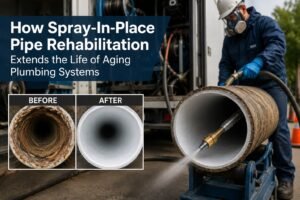
Sewer rehabilitation is the process of restoring a damaged or deteriorated sewer pipe to working condition without necessarily replacing it. Instead of pulling out the old pipe and laying new pipe in its place, rehabilitation methods work from the inside, either by relining the existing pipe or, in some cases, applying structural coatings directly to the pipe interior.
The most widely used approach for residential sewer lines is Spray-In-Place Pipe (SIPP) lining, sometimes called “drain relining” or “pipe relining.” Underground sewer pipe rehabilitation also includes Cured-In-Place Pipe (CIPP) for certain pipe conditions and robotic patch repair for isolated defects that don’t require full-length lining. The right method depends on what the pipe inspection reveals.
Signs Your Sewer Line Needs Rehabilitation
Most homeowners don’t know there’s a problem until the symptoms become impossible to ignore. Watch for these warning signs:
- Slow drains throughout the house, not just one fixture
- Gurgling sounds from toilets or drains after using water elsewhere
- Sewage odors inside the house or in the yard
- Soggy or unusually green patches of grass above the sewer line
- Recurring backups; clearing only fixes temporarily
- Cracks or sinkholes forming in the yard near the sewer line path
Any one of these warrants a camera inspection of the sewer line. A licensed plumber or sewer rehabilitation contractor will run a CCTV camera through the line to show exactly what’s going on. That inspection is the starting point for any rehabilitation recommendation, and it tells you whether lining is the right fix or whether more significant intervention is needed.
Concrete Sewer Pipe Rehabilitation: An Important Special Case
Older homes, particularly those built before the 1980s, often have concrete or clay sewer laterals that have been in the ground for 40, 50, or 60 years. Concrete sewer pipe rehabilitation is one of the most common applications of trenchless lining methods because concrete is highly vulnerable to hydrogen sulfide corrosion that occurs naturally in sewer systems. Over time, that corrosion hollows out the pipe crown and weakens the structural wall.
The good news is that SIPP and CIPP lining work very effectively in concrete and clay pipes. The liner bonds to the interior surface, seals the corrosion damage, and provides a protective barrier against further chemical attack. It also handles the root intrusion that’s nearly universal in older concrete sewer laterals; tree roots find the joints in aging concrete pipe reliably, and relining eliminates those entry points permanently.
Does Homeowners Insurance Cover Sewer Line Repair?
Standard homeowners’ insurance policies typically do not cover sewer line repair or replacement. It’s one of the gaps that catches homeowners off guard. Most policies cover sudden, accidental damage inside the home but exclude underground service lines and gradual deterioration, which is how most sewer line failures are classified.
However, many insurance providers offer a sewer line or service line endorsement, an add-on to your standard policy that covers underground pipe failures, including sewer lateral repair or rehabilitation. If you don’t currently have this coverage, it’s worth calling your provider and asking. The annual premium for the endorsement is usually modest relative to the potential repair cost.
Frequently Asked Questions (FAQs)
Is relining sewer pipe worth it?
For most homeowners, yes, and often by a significant margin. Pipe relining costs substantially less than excavation-based replacement, avoids the cost and disruption of restoring the yard or driveway after digging, and can significantly extend the service life of the pipe that permanently addresses root intrusion, cracking, and joint failures.
Does homeowners’ insurance cover main sewer line repair?
Standard homeowners’ policies usually don’t, sewer line failures are typically excluded as gradual deterioration of an underground service line. Many insurers offer a service line or sewer line endorsement that does cover it, and some municipalities provide lateral protection programs. Check both your policy and your local utility before assuming you’re uncovered.
What is sewer rehabilitation?
Sewer rehabilitation is the restoration of a damaged or deteriorating sewer pipe to functional condition through methods that repair or reline the existing pipe rather than replacing it. Trenchless sewer rehabilitation which includes CIPP lining, SIPP coatings, and robotic spot repair does this without excavation, working entirely through existing access points.
How much does drain relining cost?
Costs vary depending on pipe diameter, access conditions, and local labor rates. A camera inspection is usually required before accurate pricing can be determined.
Sewer problems aren’t something most homeowners want to think about until they have to. But when the time comes, knowing that trenchless sewer pipe rehabilitation exists and companies like Pipe Revive exist is reassuring for many homeowners.