
Imagine waking up to a soggy, foul-smelling patch in the middle of your perfectly manicured front lawn. Or worse, a hairline crack running through your expensive custom driveway. In the past, this was the beginning of a homeowner’s horror story. A fleet of backhoes would arrive and tear a deep, ugly scar through your property to reach a single leaking sewer line.
But today, the era of the “big dig” is rapidly coming to an end. Trenchless pipe rehabilitation has become a widely used solution for repairing underground infrastructure without turning your yard into a construction site.
The concept is simple, but the engineering is brilliant. Instead of digging up the pipe, the repair is performed from the inside out. Whether you are a homeowner dealing with invasive tree roots or a commercial property manager facing aging cast-iron mains, understanding how this “no-dig” method works can save you money and help you avoid weeks of disruption.
The Evolution of Trenchless Pipe Rehabilitation Technology
Modern trenchless pipe rehabilitation technology refers to a suite of underground construction and repair methods that require minimal surface disruption. Rather than digging a continuous trench, these methods usually require only one or two small access points, often called insertion pits.
From these access points, specialized equipment can clean and inspect the pipeline. It can also rehabilitate or restore it, even if the pipe is buried deep under concrete, landscaping, or roadways.
The core philosophy of trenchless pipe rehabilitation is to minimize the “footprint” of the repair. In a city environment, this is a game-changer. It means your sidewalk stays intact. Your street remains open to traffic. Your business doesn’t have to close its doors while the plumbing work is performed.
Common Methods of Trenchless Pipe Rehabilitation
When you start looking into how pipes are repaired from the inside, you will generally find three common trenchless pipe rehabilitation approaches. The choice between them depends on the current state of your existing pipes and your long-term goals.
Spray-In-Place Pipe Rehabilitation (SIPP)
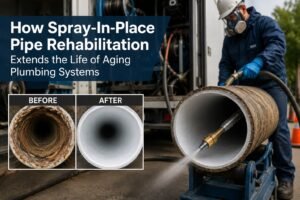
Spray-In-Place Pipe Rehabilitation (SIPP) restores aging pipes by applying a specialized epoxy or polyurea-based coating to the interior walls of the existing pipe. This process seals small cracks, improves internal flow capacity, and helps restore the interior of the existing pipe.
SIPP is commonly used for waste, vent, sewer, and select ducting systems in commercial and multi-unit buildings. Because the coating is applied internally, it can rehabilitate pipes without the need for large excavation areas.
Pipe Relining (CIPP)
Pipe relining, specifically Cured-In-Place Pipe (CIPP), creates what is essentially a “pipe within a pipe.” A flexible resin-coated liner is inserted into the existing pipe.
Once in place, the liner is cured using heat or UV light, forming a seamless interior pipe. This method works well when the original pipe is still structurally intact but has cracks, leaks, or moderate root intrusion.
Pipe Bursting
If the original pipe has completely collapsed or is too small for current needs, pipe bursting may be considered. This process pulls a cone-shaped bursting head through the old pipe.
As it moves forward, it breaks apart the existing pipe while pulling a new high-density polyethylene (HDPE) pipe into place behind it. The result is a full pipe replacement with minimal surface excavation.
The Real-World Value: Cost vs. Convenience
When property owners search for trenchless pipe repair near me, the first question on their minds is usually the cost. It’s important to look at the “total project cost” rather than just the plumber’s bill. Traditional excavation often entails additional expenses, such as repairs to landscaping, sidewalks, driveways, parking areas, or flooring, once the pipework is complete.
Trenchless pipe rehabilitation methods can reduce many of these restoration costs. In many cases, the reduced disruption and faster installation timeline make trenchless solutions the more practical option. Actual costs vary depending on pipe diameter, accessibility, and the condition of the existing system. A camera inspection is typically required before a reliable estimate can be provided.
Why “No-Dig” is the Future of Home Maintenance
Why Are Trenchless Solutions Growing in Demand? As commercial buildings, multi-unit housing, and public infrastructure age, the demand for trenchless pipe repair solutions grows.
Property owners and facility managers are increasingly choosing methods that reduce demolition while extending the usable life of existing systems. By using modern trenchless technology, repairs can often be completed faster, with fewer disruptions to surrounding structures and operations.
How does Pipe Revive Approach Trenchless Pipe Rehabilitation?
At Pipe Revive, the focus is on inspection-led pipe rehabilitation solutions. Every project begins with a detailed camera inspection and system evaluation to determine the pipeline’s actual condition.
From there, the most practical solution is recommended, whether SIPP, CIPP, preventative reinforcement, or full replacement. Using modern inspection, cleaning, and internal restoration processes, aging pipe systems can often be restored and strengthened without large excavation projects.
For many properties, this approach provides a more controlled and practical path to maintaining long-term infrastructure performance.
Frequently Asked Questions (FAQs)
What is pipe rehabilitation?
Pipe rehabilitation is the process of restoring the structural integrity and flow capacity of an existing underground pipe. This is done without replacing the entire line through excavation. It involves cleaning out debris from the pipe. Internal solutions such as epoxy liners or new pipe segments are then applied. This helps extend the system’s life by several decades.
How expensive is pipe relining?
The cost depends on pipe diameter, length, access conditions, and the repair method being used.
While the upfront quote may seem higher than a standard patch job, it saves you from the massive secondary costs. These costs can include rebuilding your landscaping or hardscaping. In many cases, the overall project value becomes clearer when surface restoration and downtime are factored in.
Is sewer pipe relining worth it?
Absolutely. Beyond the lack of property damage, the resulting pipe is seamless. Because there are no joints, tree roots, the number 1 cause of sewer failure, have no way to enter the system. It’s a long-term fix that typically carries a 50-year life expectancy.
What is the disadvantage of pipe relining?
The primary disadvantage is that it cannot be used on pipes that have completely collapsed or severely sagged (belly conditions). Since the liner follows the path of the existing pipe, if the original line has lost its slope or structure entirely, pipe bursting or traditional replacement may be the only remaining options.